📶 Signal Science

Signal Distribution Across Oman

Understanding how radio signals travel, why coverage varies, and how Oman's unique terrain shapes the reach and strength of mobile and internet networks.

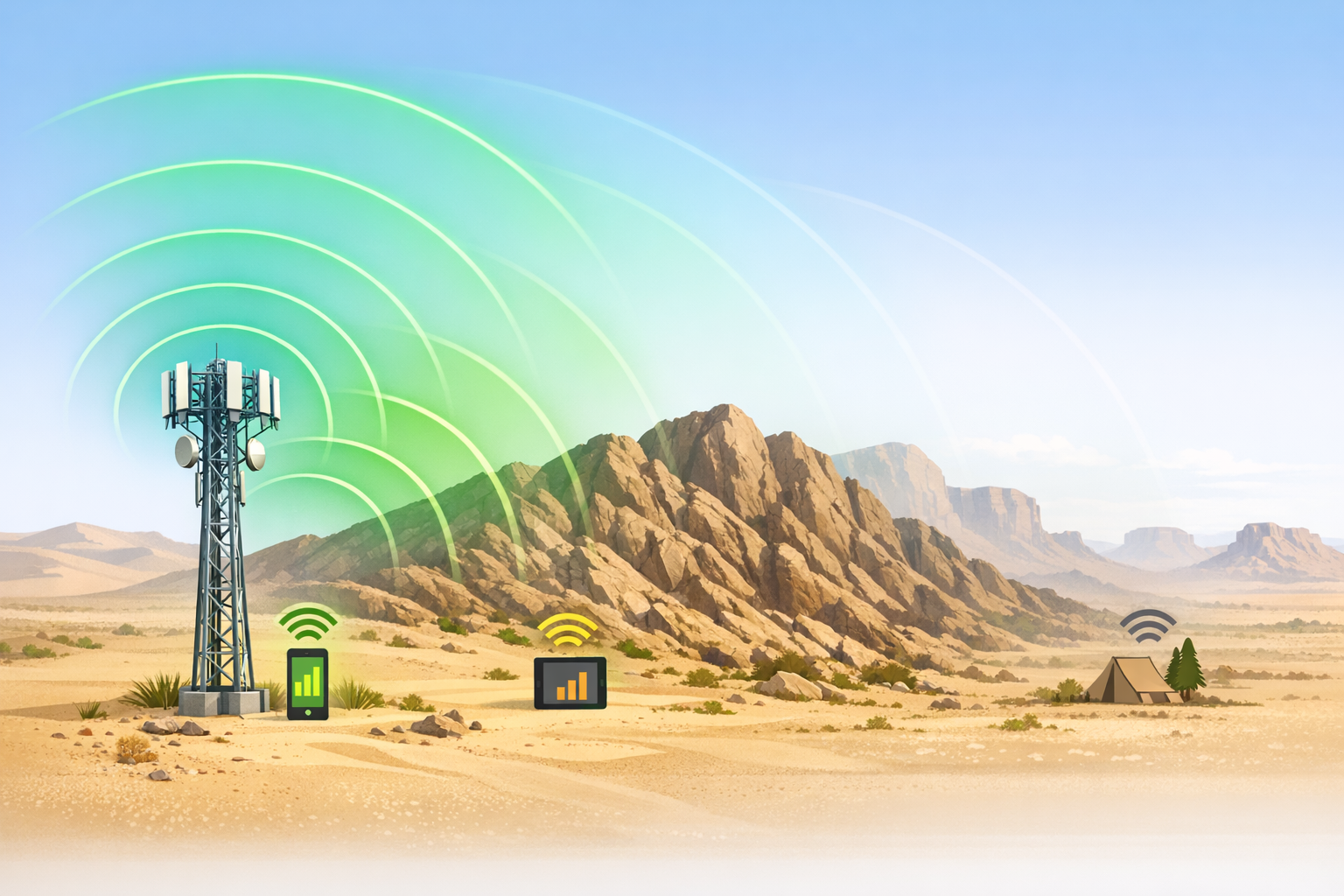
Illustration of a cell tower broadcasting signal waves across desert terrain with mountains

How Signals Spread Across Terrain

Mobile communications rely on radio waves — electromagnetic energy transmitted from base stations (towers) and received by devices such as smartphones and routers. Understanding how these waves behave in different environments explains much of the variation in signal quality experienced across Oman.

Radio waves travel outward from an antenna in all directions, diminishing in strength with distance. This natural weakening — known as free-space path loss — means that every metre of separation between tower and device costs some signal strength. Terrain amplifies this effect by introducing physical obstructions that reflect, diffract, scatter, or absorb the waves.

In Oman's context, signal engineers must account for the Hajar Mountains' steep profiles, the vast flat expanses of desert, the reflective surfaces of coastal waters, and the dense building fabric of major cities — each requiring different infrastructure strategies.

The Mechanics of Signal Propagation

Four fundamental physical processes determine how a radio signal behaves when it encounters the environment.

🔄

Reflection

When a radio wave strikes a large smooth surface — such as a building facade, a rock face, or even calm water — it bounces back at an angle. In urban areas like Muscat, this creates multiple signal paths arriving at a device from different directions. These reflections can be beneficial (extending coverage around corners) or problematic (causing interference when waves arrive slightly out of phase).

In Oman's coastal zones, the surface of the Arabian Sea and the Gulf of Oman can reflect signals, sometimes extending coverage further than the line-of-sight distance from a tower.

🌊

Diffraction

Diffraction is the bending of waves around the edges of obstacles. When a signal encounters a mountain ridge or a tall building, some of the wave energy bends around the edge, providing partial coverage to areas that are technically not in direct line-of-sight. This phenomenon is what allows some signal to reach into valleys and behind ridgelines in the Hajar Mountains, albeit at greatly reduced strength.

Lower frequency signals diffract more readily, which is why 2G networks tend to provide slightly better coverage in mountainous terrain compared to higher-frequency 4G or 5G signals.

Scattering

When a signal encounters surfaces that are rough relative to the wavelength — such as irregular rock formations, dense vegetation, or uneven ground — it scatters in many directions. This disperses the signal energy broadly, reducing strength in any particular direction. The rugged surface textures of Oman's gravel plains (known locally as "hajar" terrain) and rocky outcrops contribute to signal scattering in interior regions.

Scattering is also relevant in the Dhofar region during the Khareef (monsoon season), when airborne moisture and dense fog can scatter signals across the landscape.

🧱

Absorption

Some materials absorb radio wave energy rather than reflecting or transmitting it. Dense materials like rock, concrete, and water are particularly effective absorbers. This is why signal strength drops noticeably inside caves, in deep rocky gorges, and within heavily constructed buildings. In Oman, the limestone and granite composition of the Hajar Mountains creates a highly absorptive environment that limits signal penetration into deep valleys.

Modern construction materials — particularly those with metallic reinforcement, reflective glass, or concrete cores — can significantly attenuate indoor reception in Oman's newer commercial buildings.

Frequency Bands & Their Behaviour in Oman

Different frequency bands behave differently in terrain. The choice of frequency directly determines how far a signal reaches and how well it penetrates obstacles.

📻

Low-Band Frequencies (700 MHz – 900 MHz)

Low-band frequencies are the workhorses of rural and mountainous coverage. Their longer wavelengths allow them to travel greater distances, diffract more effectively around terrain obstacles, and penetrate buildings more readily. In Oman, these bands are critical for reaching remote interior communities and providing baseline coverage along long desert highways.

Coverage RangeExcellent
Data Speed CapacityModerate
📶

Mid-Band Frequencies (1.8 GHz – 2.6 GHz)

Mid-band frequencies offer a practical balance between coverage range and data capacity. They are the primary bands for 4G LTE deployment in Oman's urban and suburban areas. While their range is shorter than low-band signals, they support significantly higher data throughput, enabling the mobile internet experience used by millions across Muscat, Sohar, and other major cities.

Coverage RangeGood
Data Speed CapacityGood

High-Band Frequencies (3.5 GHz – 26 GHz+)

High-band frequencies, including millimetre-wave (mmWave) bands used in advanced 5G deployments, offer exceptional data speeds but have very limited range and poor obstacle penetration. Their effective range can be as short as a few hundred metres, making them practical only in dense urban environments with closely spaced infrastructure. In Oman, these bands are deployed selectively in high-density commercial and business districts of Muscat.

Coverage RangeLimited
Data Speed CapacityExcellent

Environmental Factors Unique to Oman

Oman's climate and geography introduce specific environmental variables that influence signal behaviour throughout the year.

☀️

Extreme Heat

Oman's summer temperatures regularly exceed 45°C in interior regions. Extreme heat causes thermal expansion in tower components and can accelerate equipment degradation. Electronics in base stations require sophisticated cooling systems to maintain reliable performance. Heat-induced atmospheric refraction can occasionally cause signals to travel further than usual — a phenomenon known as ducting.

🌫️

Khareef Monsoon (Dhofar)

From June to September, the Dhofar region experiences the Khareef — a unique monsoon season that brings dense fog, mist, and drizzle. The high atmospheric moisture content during this period can slightly attenuate radio signals, particularly at higher frequencies. This is one of the few seasons in Oman where weather directly impacts signal propagation in a measurable way.

🌪️

Sandstorms

Haboobs and dust storms — common in Oman's interior regions — temporarily suspend fine sand particles in the atmosphere at high density. While sand particles are not strong radio wave absorbers, extremely dense dust storms can cause minor signal scattering at higher frequencies. The primary impact of sandstorms is physical — on infrastructure maintenance and tower equipment.

🌊

Coastal Atmospheric Ducting

Along Oman's extensive coastline, temperature inversions between warm air at sea level and cooler air above can create atmospheric "ducts" — channels in which radio waves are trapped and guided over much longer distances than normal. This phenomenon, while intermittent, can result in coastal areas receiving unexpectedly strong signals from distant towers.

🌙

Day-Night Ionospheric Variation

The ionosphere — a layer of Earth's upper atmosphere — affects how certain radio frequencies propagate over long distances. During nighttime hours, ionospheric changes can cause distant signals to be received more clearly, which can occasionally cause interference in radio-based communication systems — though this primarily affects broadcasting frequencies rather than modern mobile bands.

🏔️

Altitude Effects

At higher elevations in the Hajar Mountains, the thinner atmosphere reduces some forms of signal absorption. Paradoxically, high-altitude areas can sometimes achieve line-of-sight connections to multiple towers simultaneously. However, the practical challenge remains infrastructure installation and maintenance at extreme elevations above sea level.

Signal Strength Zones: A Conceptual Overview

Signal strength is not binary — it exists on a gradient from strong to absent, with different practical implications at each level.

● Strong Signal Zone

Full multi-bar reception allowing high-speed data, clear voice calls, video streaming, and reliable navigation. Found in urban centres, major towns, and well-serviced coastal corridors. Muscat and Al Batinah coast typify this zone.

● Good Signal Zone

Reliable connectivity for standard usage including browsing, calls, and maps. Minor drops during peak hours or in enclosed spaces. Found in secondary towns, major highways, and tourist destinations with infrastructure support.

● Moderate Signal Zone

Sufficient for voice calls and basic data. Speeds are reduced and reliability is intermittent. Common in peri-urban areas, rural villages, and along secondary roads through variable terrain. Data-intensive tasks may be unreliable.

● Weak / No Signal Zone

Minimal or no connectivity. Calls may be impossible or drop frequently. Found in deep mountain valleys, remote desert interior, uninhabited areas, and certain national park zones. Satellite connectivity may be the only alternative.

⚠️ Disclaimer: OmanCoverageGuide.org is an independent informational website and is not affiliated with any telecom operator in Oman. This site does not provide mobile services, SIM cards, data plans, or payment processing. All signal information is for educational purposes only.